


Picture a founder with two options on the table. One is a machine learning hire at roughly $180,000 a year all in. The other is a quote from an AI development company in the same range. Looks like a tie. It rarely is, and the reasons are mostly dull ones nobody thinks about until the invoices start.
Call it $180,000 a year all in. That’s a round assumption: a median salary for this kind of role, plus benefits and payroll tax. Swap in your own number.
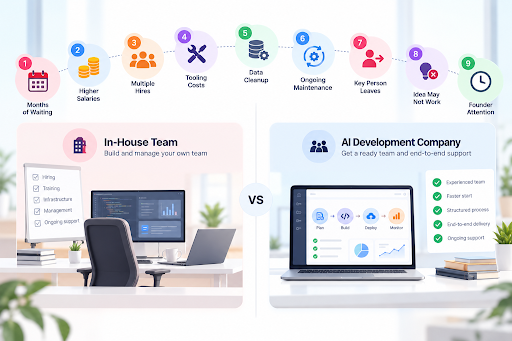
Nine costs tend to get missed.
1. Months of Waiting
Recruiter guides say 60 to 90 days to fill a machine learning role, and one quotes a median of 89 days against 42 to 48 for regular software jobs. Recruiter numbers, so loose. Call it three months. Three months of salary you aren’t paying looks like savings, right up until you notice the project didn’t move either.
2. The Salary Is the Smaller Number
BLS has no category for machine learning engineers, so the closest one is computer and information research scientists, where median pay was $140,300 in May 2025. The range is wide. One summary of the data puts the bottom tenth near $82,200 and the top tenth above $230,000. A good hire in a hot market can cost a lot more than the median.
3. The Second and Third Hire
One engineer rarely covers data pipelines, deployment, monitoring and understanding the business problem. So a data engineer arrives. Then somebody for deployment. The first hire is rarely the last, and that’s what in-house ai ml development really costs.
4. Tooling
Experiment tracking, a model registry, evaluation tools, GPU time, the cloud bill. Each one small. Together a standing monthly line, and it rises with ai ml development workload.
5. Data Cleanup
Labeling and cleaning data eats weeks. In-house, that’s expensive engineers doing unglamorous work. An AI development company has usually cleaned similar data before and quotes it separately. At least you can see it.
6. Running It Afterward
Launch isn’t the finish line. The 2015 paper on hidden technical debt in machine learning systems argues that most of the lasting cost sits around the model, in the pipelines and glue code. It keeps billing for years.
7. When the Key Person Leaves
One resignation, and the knowledge walks out the door unless somebody documented it. Agencies lose people too, but a few colleagues have usually seen the code.
8. When the Idea Doesn’t Work
Some AI ideas just don’t work out. Plenty of agent projects get shelved once somebody takes a hard look at the cost and the value. With a hired team, the salaries carry on after the idea dies. A pilot can simply stop.
9. Founder Attention
Managing a new AI team takes hours from somebody, usually the founder. Those hours were going to customers. It never shows up on a spreadsheet. Possibly the biggest cost of the nine.
Where an AI Development Company Is Cheaper
First attempt. Defined builds. Anything that can’t wait three months for a hire. A pilot done by outsiders also leaves something real for the eventual hire to inherit.
Where In-House Is Cheaper
When AI is the product, that knowledge can’t be rented forever. A mix works too: an agency builds version one, and the first hire arrives partway through and learns on the job.
The Sum
Do the math on that $180,000 hire. It’s $15,000 a month. The search takes three months, so the first working month is month four, and an 18-month window holds 15 paid months. That’s $225,000 before the second role, the tooling or the data cleanup. Put the agency quote beside it, line by line. Sometimes the agency comes out well ahead. Sometimes the hire does. The quote decides, not instinct.
BiztechCS, which delivers AI/ML Development and GenAI Solutions for mid-market businesses, gets asked this early. The line most founders leave blank is the ai ml development upkeep after launch.
