


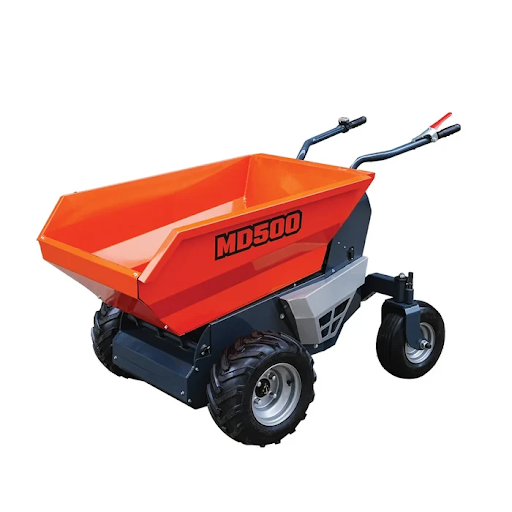
Battery machines get compared against engines on power, which is the wrong axis. An electric drive and a small gasoline engine deliver their output in fundamentally different shapes, and on a loaded machine crawling up a ramp the shape matters more than the peak. An electric wheeled dumper is a different tool from its gasoline equivalent, not a quieter version of one.
Torque before movement
The motor in an electric wheelbarrow produces its maximum turning effort at zero revolutions. Standing still with a full hopper against a slope, it is already making everything it has, and it will hold position or move off without any of the clutch slipping a combustion machine needs.
A small engine does the opposite. Peak torque arrives somewhere in the middle of its range, so getting a load moving means raising revolutions first and feeding a clutch, which is where most of the heat and most of the wear in a gasoline machine comes from.
Runtime is rated in hours and work is counted in loads
A ten hour figure on a specification sheet is measured under a defined load, usually something gentler than a real site. The number a crew actually needs is how many loads the machine will move before it stops, and nothing on the sheet answers that.
The conversion depends entirely on gradient and surface. Flat hard ground over short distances might give a full day on one charge, while repeated climbs on soft ground can halve it, because climbing is where the current draw multiplies.
Where the current actually goes
Rolling an electric wheelbarrow on level ground costs very little. Lifting the hopper costs a brief surge. Climbing costs continuously and in proportion to both the load and the slope, which is why the same machine gives wildly different answers on two different sites. Operators learn this quickly and route around it. Choosing a longer flat path over a shorter steep one saves more battery than any adjustment to how the machine is driven.
Charging is a planning problem, not a technical one
A battery wheelbarrow that needs eight hours to charge and gives ten hours of work is a one shift machine, which is fine for most users and useless for two shifts. The question to settle before buying is whether the charge window fits the working day.
Three habits extend pack life:
- Charge after use, not the next morning
- Avoid running the pack fully flat
- Store it charged through a cold winter
The last matters in Canada. A lead acid pack left discharged in an unheated shed will freeze and will not recover, and a lithium pack stored flat loses capacity permanently even when it does not freeze.
Where emissions rules decide the machine
Indoor work, food premises, tunnels and basements are places a combustion engine is either prohibited or needs ventilation that costs more than the machine. An electric wheelbarrow is often chosen for access rather than for running cost.
Noise does the same job in residential work. A machine that can run at seven in the morning without a complaint buys working hours that a gasoline unit does not get, and on short urban jobs those hours are the whole schedule.
Hydraulic tipping and what it adds
A hydraulic hopper empties without the operator lifting anything, which is the difference between a machine one person can run all day and one that needs two. It also lets the load be discharged in stages, which matters when spreading rather than dumping.
The cost is maintenance and a second thing to charge. On an electric machine the tipping pump draws from the same pack, so a day spent tipping frequently is a shorter day than a day spent hauling.
What maintenance disappears and what replaces it
A power wheelbarrow driven by a battery needs no oil changes, no filters, no spark plug and no fuel going stale over winter. For a machine used occasionally, removing stale fuel alone is worth a great deal, because that is the single most common reason a seldom used gasoline machine refuses to start.
What replaces it is pack management and brake wear. Electric drives are often geared to hold on a slope, so the mechanical brakes do less, while the wheel bearings and tires take the same abuse they always did.
Payload against what the ground will carry
Eleven hundred pounds is the machine rating. The limit on a soft lawn or a new slab is the ground, and a loaded dumper concentrates its weight onto four contact patches that are far smaller than a wheelbarrow tire.
TMG Industrial builds this one as a 48 volt machine with hydraulic tipping and a ten hour battery rating. Working out the number of loads per charge on the actual site, rather than accepting the hour figure, is what decides whether one battery covers the job.
