


Losing a single tooth creates an immediate gap you can see and changes you cannot. Neighboring teeth may drift, the opposing tooth can over-erupt into the space, and the jawbone at the site gradually thins without the stimulation of a root. Many patients ask whether a single-tooth implant or a traditional bridge is the better way to restore form and function. This article explains how each option works, the trade-offs to consider, and scenarios where one approach often makes more sense than the other.
What Changes in Your Mouth After a Tooth Is Lost
For context, resources like Dental Implants of Boynton Beach outline the components used to replace a missing tooth. The key biological point is simpler: bone responds to load. When a root is gone, the socket remodels, and the ridge becomes narrower. Meanwhile, neighboring teeth may tilt toward the gap, and the tooth above or below can drift into it, complicating the eventual fit of any restoration.
Time matters because these movements change your bite. A space that was straightforward to restore shortly after an extraction can require additional steps later, such as orthodontic uprighting or enamel contouring to regain room. Some patients also choose a socket-preservation bone graft after extraction, which can help maintain ridge volume for a future implant. Knowing how quickly changes can occur helps you plan the timing of your replacement realistically.
How a Single-Tooth Implant Differs From a Three-Unit Bridge
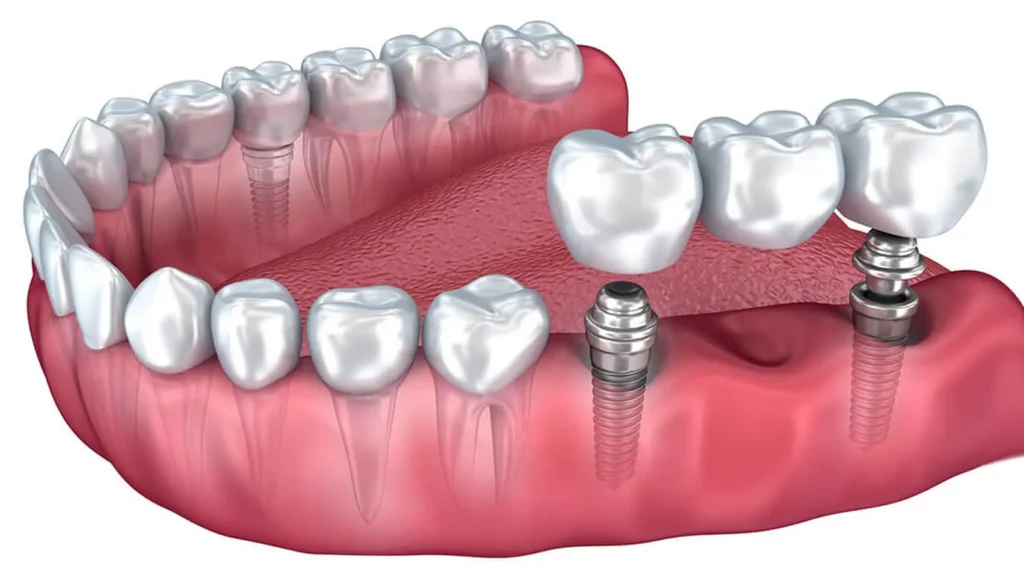
A single-tooth implant uses a titanium or zirconia fixture placed in the bone, an abutment that connects above the gumline, and a crown that matches the bite and shade. After healing and osseointegration, you brush and floss an implant-supported crown like a natural tooth. The chewing load transfers into the bone at that site, which can help maintain the ridge profile and support soft tissue contours, especially in the front of the mouth.
A three-unit bridge uses the teeth on either side of the gap as abutments. The dentist prepares those teeth by reducing enamel; each receives a crown, and a solid pontic spans the space. A bridge does not replace a root, so it does not prevent bone loss under the pontic. Daily cleaning requires a floss threader, super floss, or a water flosser to sweep under the pontic. Because the abutment teeth are drilled, the risk of decay at the margins and the possibility of future root canal treatment can increase over time.
Trade-offs That Matter: Surgery, Timeline, and Long-Term Risk
Implants involve a minor surgical procedure and a healing period before the final crown is attached. Depending on bone quality and site anatomy, your dentist may recommend a bone graft, a custom healing abutment to shape the gum, or a temporary partial to fill the gap while you heal. A cone beam CT (CBCT) scan guides safe placement by showing bone thickness, the maxillary sinus, and the mandibular nerve. Bridges avoid surgery and are often completed faster, but they rely on altering adjacent teeth to carry the load.
Mechanical forces and biology shape long-term risk. For heavy grinders, uncontrolled bite forces can chip porcelain or loosen small screws on implants; a custom night guard often helps. Bridges concentrate force on the abutment teeth; if one fails, the entire bridge can be lost. Implants are not immune to problems either. Poor plaque control can inflame the tissues (peri-implant mucositis) and, if neglected, threaten the bone (peri-implantitis). A common mistake is rushing into a bridge to avoid surgery when the neighbors are healthy, or scheduling implant surgery before active gum disease is under control.
Real-World Scenarios to Clarify the Choice
Scenario one: A front tooth fractures at the gumline in a patient with two untouched neighboring teeth and a high smile line. An implant-supported crown often preserves those neighbors and supports the gum architecture over time. A bonded temporary or a clear retainer with a tooth can fill the space during healing, while a custom healing abutment helps shape the soft tissue for an aesthetic outcome.
Scenario two: A lower first molar is missing, and both adjacent teeth already have large, failing fillings that need full-coverage crowns. In that case, a three-unit bridge can be efficient because those abutments benefit from crowns anyway. Scenario three: An upper molar has been missing for years, and the sinus has drifted downward, leaving limited bone. Choices may include sinus augmentation with a graft, a shorter implant designed for limited height, or a bridge if bone augmentation is not desired. For smokers or patients with uncontrolled diabetes, stabilizing health first is prudent before any implant plan.
Maintenance After Either Choice: Daily Cleaning and Checkups
Bridges demand meticulous cleaning under the pontic to prevent gum irritation and decay at crown margins. Many patients use a floss threader or super floss daily to sweep plaque from the tissue-facing surface, adding a water flosser to rinse debris. Hygienists check contact points, polish crown margins, and monitor abutment teeth on radiographs. If a bridge looseness or a recurrent cavity appears, early repair is simpler than waiting until sensitivity or fracture occurs.
Implants benefit from the same daily habits you use for natural teeth, with a few extras. A soft brush and low-abrasive toothpaste protect the crown’s surface, and woven floss or specialty picks can clean around the abutment. Water flossers help disrupt plaque at the emergence profile. At professional visits, teams use implant-safe instruments and take periodic radiographs to assess the bone crest. For bruxers, wearing an occlusal guard helps protect the crown and abutment. Watch for early signs like bleeding, swelling, or persistent bad taste and schedule an evaluation if they appear.
There is no one-size-fits-all answer, but there is a reliable way to decide. Ask your dentist three questions: What is the condition of the adjacent teeth, what is the bone and gum anatomy at the site, and how will you maintain the restoration long term? Ask to review your CBCT images for bone volume and nearby structures, discuss provisional options during healing if you pursue an implant, and clarify daily cleaning for either choice. Thinking in terms of biology first, time second, and maintenance always helps you choose confidently and care for the result well.
