


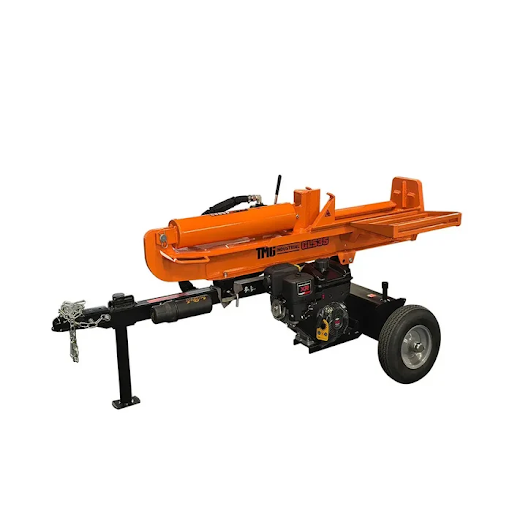
Firewood season in Australia has a short window, and anyone cutting for a whole winter is counting rounds per hour rather than admiring a force figure. Thirty-five tons sounds decisive on a badge and is almost never the thing that limits output on a real pile.
What limits it is how long each stroke takes from start to finish. A tow-behind log splitter with a slow return cycle will process less wood across a day than a lower-rated machine that resets quickly, and that holds true on almost any pile.
Why Tonnage Is Rarely the Limit
Most Rounds Need Far Less
Clean straight eucalypt splits at a small fraction of thirty-five tons. The figure exists for the knotted, stringy and forked pieces that stop a smaller machine dead, and those are a minority of any load even in the more difficult species.
The Stroke Has Three Parts
Every stroke has three parts: advance, split and return. Only the middle one does any work, and on many machines the return is the longest of the three, which means the operator spends more of the day waiting for the ram than splitting with it.
Two-Stage Pumps Change the Arithmetic
A two-stage pump moves the ram quickly at low pressure until it meets resistance, then drops to high pressure and low speed for the split itself. That is what gives a hydraulic log splitter both a fast approach and real force.
Where to Look in the Specification
Cycle time in seconds tells more about daily output than tonnage does. A machine quoting both lets a buyer work out roughly how many rounds an hour is realistic rather than guessing from the force figure.
Horizontal Against Vertical
Lifting Is the Constraint
A horizontal wood splitter requires every round to be lifted up onto the beam, and on the larger rounds that lifting becomes the limiting factor well before the hydraulics ever do. It is also where the back injuries come from.
Vertical Removes the Lift
Operating a wood splitter vertically lets a heavy round be rolled into position rather than lifted, which matters most on exactly those pieces needing the most force. The tradeoff is working at ground level with a bent back for the whole session.
Convertible Designs
Machines that do both let an operator work horizontally on the manageable rounds and switch over for the awkward ones. That flexibility costs weight and a little rigidity, which is a reasonable trade on the mixed pile most properties actually produce.
Towing and Setting Up
Being towable changes where the machine can work.
On a rural property that usually means working at the woodpile itself rather than carting rounds back to the shed and then carting split wood out again, which removes an entire handling step from the day.
A few points decide whether that works in practice:
- Road-legal lighting and a rated coupling
- Level ground for the beam, checked each time
- Wheel chocks rather than relying on the handbrake
- Clear space behind for split halves to fall
A log splitter attachment driven from a tractor removes the engine and all its maintenance entirely, which suits a property that already has spare hydraulics available at the rear. A towable machine carrying its own engine goes where no tractor can reasonably get to.
Keeping Hands Clear of a Closing Wedge
Two-Hand Operation Exists for a Reason
Controls requiring both hands keep both of them well away from the splitting zone by design. Defeating that with a tie-down or a prop is the single most common modification owners make, and it is the one that produces the amputations this equipment is known for.
Never Hold a Round
A piece that needs steadying should be stopped and re-set rather than held in place. The force closing on it does not distinguish between timber and a hand, and the wedge gives no warning at all before the round finally lets go.
Split Halves Fall
They fall unpredictably and with real weight behind them, so the area around the beam stays clear and boots stay on throughout. A firewood splitter working at any sort of pace produces a hazard on the ground as well as one at the wedge itself.
Where Splitter Design Is Heading
Faster cycle times at the same tonnage have become the main selling point as buyers have learned to read them, and four-way wedges that quarter a round in one stroke are spreading from commercial processors into farm machines. Log lifts are increasingly supplied as part of the machine rather than as an accessory.
For an operator the useful comparison is rounds per hour rather than tons of force. TMG Industrial lists cycle time, tonnage and beam orientation together, which allows a machine to be matched to the species and the volume a property actually puts through it.
