


Getting the wrong product on the wall costs you twice: once for the graphic that peels at the corners inside a few months, and again for the wall that has to be stripped and made good afterwards. Decals and wall coverings get quoted against each other on the same brief, and the two terms often get used as if they mean the same thing. They don’t.
The gap between them shows up in cost, installation time, surface preparation and how the finished space reads. The question usually lands at fit-out stage, once the artwork is signed off and nobody has checked what the walls are actually made of.
What is a Decal?
A decal is a vinyl graphic with an adhesive backing. It arrives on a carrier sheet, gets positioned on the wall, squeegeed down, then the transfer tape peels away and leaves the graphic behind. Cut vinyl is plotted from a solid colour of film, so no background sits behind the design and the wall colour shows through the gaps in the letters.
Printed vinyl carries full-colour artwork and is contour cut to the outline, which is how personalised wall stickers are produced with names, dates or artwork of your own. Typical jobs include reception logos, door numbers, opening hours on glazing, wayfinding arrows, safety notices and feature lettering in bedrooms or classrooms. Adhesive grade runs from permanent to low tack, so ask which one the quote covers.
What is a Wall Covering?
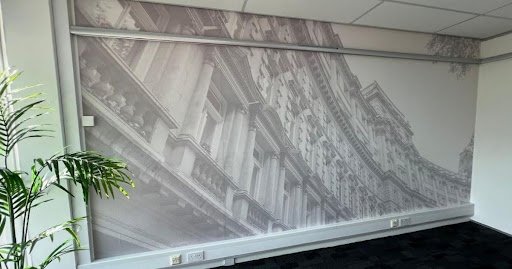
A wall covering is a printed material installed in drops across a full wall or a large section of one. It gets printed wide format onto paper-backed vinyl, self-adhesive film, textile or a non-woven substrate, then hung by an installer who butt-joins each drop and trims around skirting, sockets, switches and corners.
The result is a continuous surface rather than a graphic sitting on top of paint, so the printed vinyl carries the whole wall instead of one shape on it. Photographic murals, repeating patterns, brand colours, subtle textures and full-height imagery all belong in this category. Coverage starts at a couple of square metres and scales up to every wall on a floor, which is where pricing parts companies with decals.
Which Works Better for Your Space?
The right choice comes down to three things: how much wall the design has to fill, how long it needs to last, and how likely it is to change. Work through those before you look at samples.
When a Decal is The Right Call
An icon logo, lettering, glazing manifestation, wayfinding, safety notices and any design you expect to update all point towards decals. They suit tenanted units too, since removable film leaves the wall as you found it at the end of the lease.
Budget is a factor as well, because a single graphic costs the same in a small office as it does in a large one, so a small brand mark stays affordable in a space of any size. Lead times are shorter as well, since a cut or printed graphic needs no installer diary slot and no wall preparation beyond a clean surface and a dry day.
When a Wall Covering Wins
Full-wall imagery, immersive interiors, feature walls in offices and hospitality, and artwork that runs edge to edge without a border of paint around it all call for a covering. Past roughly a third of the wall, a covering looks cleaner than an oversized decal. It also hides minor surface flaws that a decal would sit on top of and highlight, which saves a redecoration before the graphics even arrive.
Where a space has to feel designed rather than branded, a covering carries pattern, texture and colour across the whole surface in a way that no single applied graphic manages. A laminated covering also takes knocks in a busy corridor that would lift a decal edge.
Using Both Together
Plenty of schemes combine the two: a mural behind a reception desk, a cut vinyl logo applied over it, frosted decals on the glass partitions beyond. Specify the finishes together so the sheen levels match, since a gloss graphic on a matt covering reads as an afterthought.
Order both from one supplier where you can, and colour matching gets easier, because the same printer, profile and laminate run across the whole scheme. Sequence the install too. Coverings go up first and need to settle before anything is applied over them, so book the decals for a later visit.
Getting the Finish You Wanted
Decals sit on the wall. Coverings become the wall. That one distinction settles more briefs than any spec sheet, because it forces the real question: how much surface does the design have to fill, and how long does it need to stay there? Measure the area, check what the wall is actually made of, and be honest about how long the artwork will stay relevant before you commit either way.
A decal handles anything you expect to swap out. A covering handles anything meant to define the room. Ask your supplier for a sample of both against your own lighting and paint finish, and get the adhesive grade in writing, since that is where the cost of removal is decided.
