


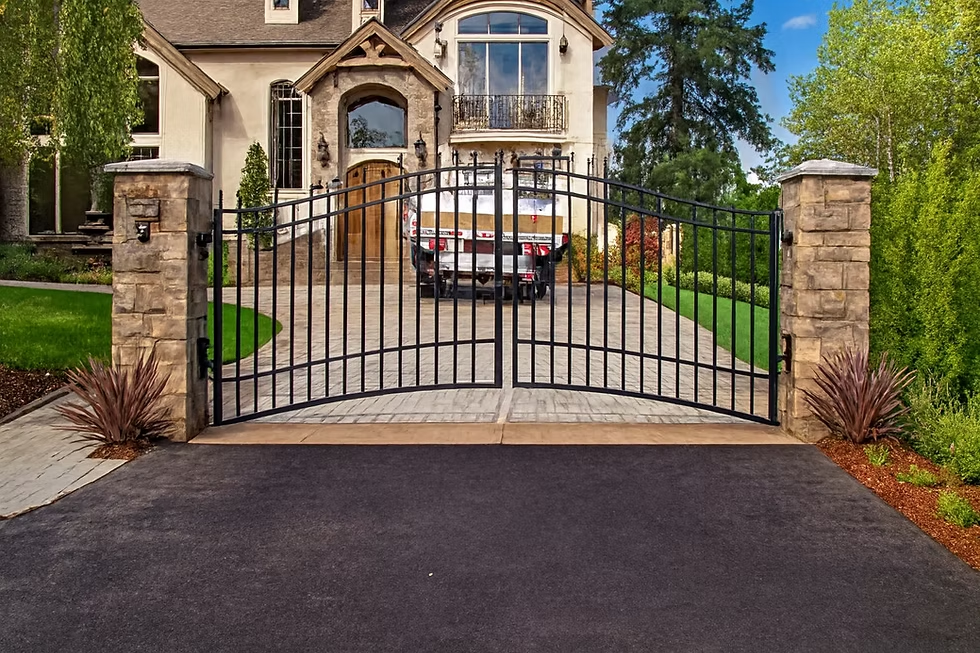
Gates look simple until a driveway pitches up or down. Even a modest grade can force a swing gate to scrape the pavement, make a sliding gate pull itself downhill, or overwhelm an automatic opener. If you are planning a new gate or troubleshooting one that misbehaves, start by treating slope as a primary design constraint, not an afterthought. The right choice between a swing or sliding design, the type of track or rollers, and details like hinge type, post footing depth, and opener settings all depend on how your gate must move through space on that incline.
-
Measure the Grade and the Path Your Gate Must Travel
The first task is to quantify your slope where the gate will operate. A simple builder’s level, a 4 foot level with a tape measure, or a smartphone clinometer can give you rise over run. Compare that to the swing arc of a full gate leaf or the travel path of a sliding panel. A 12 foot swing gate on an uphill driveway needs enough bottom clearance to pass over the high point in its arc; a sliding gate needs straight, obstacle free space equal to its opening width plus any counterbalance. If a driveway gate is already binding or dragging, resources such as Salem gate repair and installation from F&W Fence Co. Inc. outline how repairs and layout changes address these geometry problems.
As you measure, mark three specific references: the hinge post side grade, the centerline of travel, and the latch side grade. Slope can vary across the opening, and a crown or depression at midspan can sabotage clearance. For sliders, verify lateral space along the fence line and check for grade breaks where a V track could high center or where a cantilever tail might dip. Underground elements matter too; flag sprinkler heads, shallow utilities, and root zones where deep concrete footings or conduit runs for a keypad and loops may conflict.
-
Swing Gates on Grades: Limits and Workable Fixes
Uphill swings are the classic trouble spot. If your gate must swing uphill, rising or ramp hinges can lift the leaf slightly as it opens, but they add friction and load to the hinge pins and any opener arm. Bi parting leaves reduce each panel’s arc and weight, making clearance easier and hinge stresses lower, though you will need a reliable drop rod and latch alignment. Another workaround is raking the bottom rail to follow the grade, but that increases the gap at the low side, which can be a problem for small pets or security. A realistic scenario: a 10 foot cedar clad steel frame swings uphill, clears fine in summer, then swells and sags in winter rains. Here, deeper hinge post footings, sealed wood cladding to reduce seasonal weight change, and a positive stop at 90 degrees can stabilize performance.
-
Sliding Gates: V Track Versus Cantilever on Uneven Ground
On sloped or debris prone drives, the choice between V track and cantilever is decisive. V track sliders ride on a ground embedded track with V groove wheels; they are smooth and compact but hate gravel, ice, and sand washed into the channel. If the track crosses a drainage path at the bottom of a hill, the gate can jam or derail. Cantilever gates hang off rollers mounted to steel posts and “float” past the opening with no track on the driveway, making them ideal for grades, snow, and gravel. The trade off is space and structure: a cantilever needs a counterbalance section roughly half the opening width, plus stout posts and deep concrete footings to carry the load. Picture a 14 foot opening: the cantilever tail might extend another 6 to 8 feet, demanding clear fence line and careful placement of guide rollers and the catch post.
-
Automation on an Incline: Safety Devices and Power Control
Gravity complicates automation. Slide gates on a slope can roll under their own weight unless the operator has a mechanical brake and positive end stops. Swing operators on rising hinges work harder at startup, so look for soft start and soft stop profiles, higher torque, and duty cycles that match the gate’s mass and frequency of use. Safety is nonnegotiable: place photo eye sensors at heights that catch bumpers and pedestrians, add monitored edge sensors on leading edges where entrapment is possible, and consider in ground loop detectors to prevent a closing cycle when a vehicle is present. Ensure the manual release is reachable without stepping into the swing arc on a hillside. For power resilience, a battery backup prevents a stuck open or stuck closed situation during outages, which is especially helpful when a slope makes manual pushing risky.
Installation Details That Keep Gates True Over Time
Gates on grades magnify small construction flaws. Set hinge and roller posts in concrete below the local frost depth, bell the footings to resist uplift, and use rebar cages to minimize rotation. Align posts plumb and parallel; even a quarter inch lean compounds across a long leaf. On metal gates, hot dip galvanizing and powder coating slow corrosion at welds and hinge sleeves; on wood infill, seal edges to curb water weight. Route electrical in buried PVC conduit with radius sweeps to protect low voltage cable to keypads and intercoms, and bond metal components to ground to minimize shock risk from faults. After installation, build a maintenance routine: clear any V track weekly in leaf season, check cantilever roller bearings and guide caps quarterly, lubricate hinge knuckles with a lithium or PTFE grease, and verify photo eye alignment twice a year. A 15 minute seasonal check can catch loosening anchor bolts, sensor misalignment, or a roller starting to develop a flat spot before they turn slope from a manageable constraint into a chronic service call.
When slope drives the conversation early, the gate you build is the gate that keeps working. Measure the grade where the gate actually travels, pick a swing or slide design that suits that geometry, and size posts, footings, and automation to handle the loads. Expect trade offs: a cantilever’s longer tail versus a V track’s sensitivity to debris, or a larger bottom gap under a raked swing panel versus tighter pet containment. Respect those realities in the layout and details, and you get predictable clearances, smoother operator cycles, and safer movement on the incline. Done right, the driveway’s pitch becomes a design parameter, not a reliability problem.
