


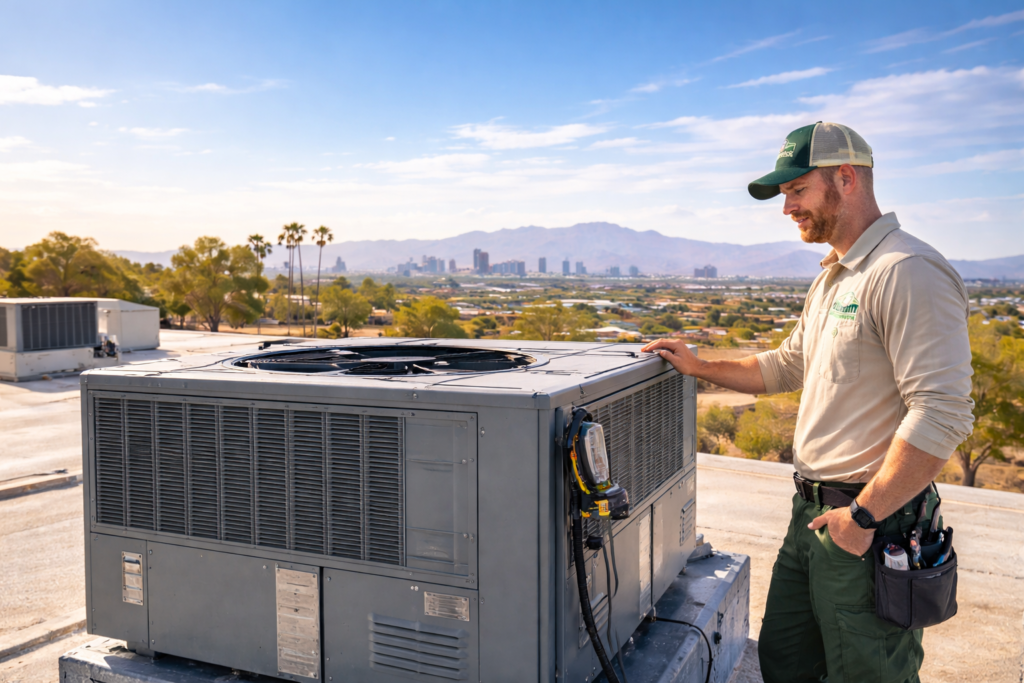
In the West Valley, many homes push their air conditioners hard by midafternoon. When outdoor temperatures push past 110 degrees, even well-maintained systems can run nonstop while indoor rooms still feel warmer than the thermostat setting. Many homeowners are surprised to learn that cooling struggles on extreme days are often less about a failing unit and more about airflow limits, indoor heat gain, and thermostat strategy. This guide explains how desert heat changes AC behavior, what details inside your home matter most, and practical steps you can take to reduce the system load before you pick up the phone.
-
How Extreme Heat Affects AC Capacity and Run Time
As outdoor temperatures climb, the condenser has to reject more heat, head pressure rises, and the system’s effective capacity drops. That is why supply air can feel less cool, and cycles get long during a heat wave. If you expect 72 degrees at 3 p.m. after a day of baking sun, you are likely to be disappointed. On the flip side, many non-cooling calls trace back to avoidable bottlenecks like clogged filters or duct leakage, not a failed compressor. If you are unsure whether low airflow or high heat gain is the root cause, a local evaluation from professionals such as Semper Fi Heating and Cooling near Peoria can separate comfort issues from equipment faults.
Consider a common scenario: you set the thermostat to 86 while away for a weekend, then drop it to 74 at 5 p.m. on Sunday. At that hour, the attic may be 150 degrees, west-facing rooms are soaking up late sun, and the AC fights both stored heat in materials and active solar gain. Recovery takes hours. Pre-cooling earlier in the day, then using a modest evening setback, lightens the afternoon load and shortens run time when electricity demand and indoor needs peak. During monsoon humidity, letting the system run long enough to pull moisture off the evaporator coil further improves comfort.
-
Airflow Basics: Filters, Returns, and Static Pressure
Airflow across the evaporator coil drives capacity. A restrictive 1-inch high MERV filter can send static pressure skyward, starving the coil and sometimes leading to icing. If you want higher filtration, a deeper 3– to 5-inch media cabinet often delivers cleaner air with lower resistance. Also check return grilles: grilles that are too small, blocked by furniture, or choked with dust reduce cubic feet per minute, or CFM. Closed interior doors can split rooms from returns, forcing air to leak under thresholds instead of flowing through designed pathways.
Low airflow shows up as weak supply from registers, excessive temperature drop at one vent, or frost on the suction line outside. The fix may be as simple as replacing a clogged filter every 30 days in peak season, opening all supply registers, and clearing rugs from floor vents. If static pressure remains high, a technician can measure it at the air handler and adjust blower speed or recommend added return capacity. Variable speed blowers help but cannot overcome severely undersized returns or crushed flex duct. Addressing airflow first prevents wasted service calls and protects the compressor from stress.
-
Heat Gain Inside the House: Attics, Windows, and Ducts
Even perfect airflow struggles against excessive heat gain. In many West Valley homes, the attic becomes a giant radiator. Inadequate insulation over the ceiling plane, unsealed can lights, and leaky pull-down attic stairs allow hot air and radiant energy into living areas. Sealing penetrations, improving attic insulation, and adding a radiant barrier where appropriate reduce ceiling temperatures and ease the AC’s job. Duct leakage compounds the problem by dumping cooled air into a superheated attic and pulling hot attic air into returns. Mastic seal joints, straighten kinks in flex duct, and insulate any exposed supply runs to keep supply air colder all the way to the registers.
Windows are another major source of heat gain, especially west-facing panes. Low-e glass, exterior shade screens, or quality window films cut solar heat without darkening interior spaces too much. Interior blinds alone block light but not all radiant heat. Outside, keep the condenser coil clean and free to breathe. Trim vegetation back 2 to 3 feet on all sides and above, and gently rinse coil fins when the unit is off and cool. Avoid surrounding the condenser with decorative enclosures that trap hot air; good airflow is more valuable than shade if shade restricts discharge air.
-
Smarter Thermostat Strategies for Pre-Cooling and Setbacks
Thermostat scheduling can work with the climate, not against it. On forecasted 110-degree days, program a pre-cool so the home reaches your comfort setpoint by early afternoon, not after peak heat arrives. For example, reach 74 by noon, then float up a couple of degrees in the evening as outdoor temperatures fall. That sequence reduces the gap between indoor and outdoor temperatures when the sun is most punishing, so the air conditioner doesn’t face an impossible catch-up.
Aggressive setbacks can save energy in mild weather but backfire in Phoenix summers. If your system is slightly undersized or faces heavy heat gain, a big afternoon pull-down can make the evaporator coil run cold for hours, risk coil icing in marginal airflow situations, and leave rooms sticky during monsoon periods. Moderate setbacks paired with a steady, earlier pre-cool usually win on both comfort and runtime. If humidity spikes in your home office or bedrooms, extend run times in the late afternoon to allow moisture to condense on the coil and drain away through the condensate line.
When Targeted Upgrades Make Sense: Zoning, Duct Repairs, and Mini-Splits
Some hot spots call for focused fixes. A classic case is a room over a garage that bakes after lunch. Causes often include radiant heat from the garage ceiling, undersized ducts, and no dedicated return. Solutions range from adding a return grille and sealing the garage ceiling to increasing supply CFM or installing a small ductless mini-split for that space. The trade-off is simplicity versus precision: duct repairs and balancing leverage existing equipment, while a mini-split adds capacity and zoned control where the main system struggles.
Elsewhere, balancing dampers in branch ducts, upsizing a chokepoint return, or replacing a restrictive 1-inch filter rack with a deeper media cabinet can unlock airflow your system already paid for. Before replacing equipment, ask for measurements: total external static pressure, supply temperature, and duct leakage. If the numbers improve after sealing and resizing, you get more sensible cooling delivered to rooms without touching the condenser. For many homes, trimming heat gain and restoring design airflow accomplishes more than a ton of extra capacity ever could.
Desert summers test every weak link. Start with what you can control: a clean, appropriately sized filter, open supply registers, clear returns, and a condenser with room to breathe. Then reduce heat gain by tightening the attic and shading glass that sees afternoon sun. Use pre-cooling to keep your system ahead of the curve. If comfort still lags, measured airflow and duct repairs often deliver bigger gains than a wholesale replacement. And when you do call a pro, ask for data, not guesses, so the fix targets the real bottleneck.
<iframe src=”https://www.google.com/maps/embed?pb=!1m18!1m12!1m3!1d3323.9277697880398!2d-112.26825057805245!3d33.58122460361628!2m3!1f0!2f0!3f0!3m2!1i1024!2i768!4f13.1!3m3!1m2!1s0x445add2618a710cb%3A0x429c0f76a78abb70!2sSemper%20Fi%20Heating%20%26%20Cooling%20LLC!5e0!3m2!1sen!2sno!4v1774384830530!5m2!1sen!2sno” width=”600″ height=”450″ style=”border:0;” allowfullscreen=”” loading=”lazy” referrerpolicy=”no-referrer-when-downgrade”></iframe>
