


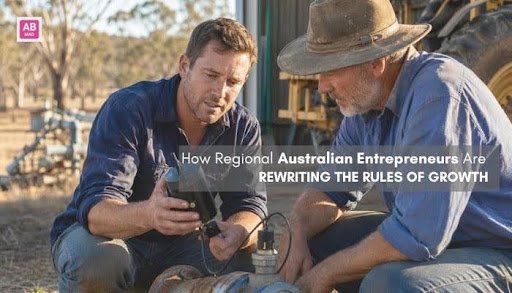
Regional founders are cutting overheads, leaning on tight local networks, and solving real problems in their own backyard. So it’s no surprise that businesses outside the capital cities are growing steadily (without the stress of oversaturated markets or sky-high rents).
If you’ve ever felt like the real opportunities only exist in Sydney or Melbourne, you’re not the only one. And yet, 10 million Australians now call the regions their home, and a growing number of them are building businesses that city founders would envy.
The team at Australian Business Magazine has been tracking this shift closely. Here, we cover the cost advantages, community networks, founder behaviours, and funding gaps shaping regional business growth.
Let’s get into it.
What Melanie Perkins and Cliff Obrecht Proved About Starting Outside the Cities
Melanie Perkins and Cliff Obrecht didn’t launch their company from a Sydney co-working space. They co-founded it in Fremantle, Western Australia, and venture capitalists rejected them over 100 times before funding came through.
Most founders would’ve relocated to Sydney after the tenth no. Perkins and Obrecht didn’t, and that stubbornness drove everything that followed. ABmag has noticed that regional founders tend to push further after rejection, possibly because they’ve already had to fight harder to be taken seriously.
Today, their company sits north of $42 billion USD in value. Every single one of those 100 investors who passed is now watching it from the sidelines.
Why Regional Australia Is Producing the Next Generation of Founders
Regional Australia is producing the next generation of founders, and lower costs, tighter networks, and less competition are the reasons why. With regional moves now at record levels, the shift is already well underway.
Time and again, two factors keep coming up: cost and community.
Regional Founders Keep More of What They Earn
Regional overheads are a fraction of city rates (Sydney commercial rent alone averages over $1,100 per sqm annually). For example, a founder who saves $50,000 in annual rent can redirect that into hiring, product development, or client acquisition.
Meanwhile, city-based startups burn through their early capital just keeping the lights on, so a regional founder starts year one already ahead, with money that actually goes toward building something.
In Regional Australia, Everyone Knows Everyone
A regional town is basically a group chat where everyone’s already talking about you, for better or worse. In places like Ballarat or Bendigo, a single good client relationship can open doors to five more through word of mouth alone.
What’s more, regional business communities actively support each other through referrals, shared resources, and local events. And that kind of network builds itself, without a single paid campaign.
What Australian Entrepreneurs Outside Capital Cities Do Differently
Unlike city-based founders chasing market trends, regional Australian entrepreneurs solve problems their own community already faces. That local focus builds expertise quickly, and it shows up in how their businesses grow.
Put them side by side, and the difference is hard to ignore.
| Behaviour | Regional Founders | City-Based Founders |
| Problem focus | Solve local, immediate problems | Chase broader market trends |
| Client base | Build deep loyalty early | Scale volume quickly |
| Marketing | Word-of-mouth driven | Paid and digital heavy |
| Overhead approach | Lean from day one | Higher burn rate early |
| Growth style | Steady, community-rooted | Fast, investor-fuelled |
Regional founders who solve local problems early build a client base that sticks (35% of all Australian businesses operate regionally, and that share keeps growing).
If you’ve ever bought from a local business just because you trust the owner, you already know how powerful that loyalty is. It gives founders clearer demand signals and better information when it’s time to expand.
Funding and Talent: Why Regional Founders Still Struggle
For regional founders, the two hardest things to lock down are funding and talent. Both concentrate in capital cities, leaving regional founders with limited access to either.
Venture capitalists want face time, and regional founders rarely get it, so bootstrapping becomes the only option for years. That means slower hiring, leaner teams, and less money for product development. What’s more, some founders are still swimming upstream in their early years in the journey (the pipeline simply wasn’t built for them).
From what ABmag has seen, most Australian investors still make funding decisions based on proximity rather than potential. Regional founders are finding alternatives though, with federal grants and programs offering real support outside the traditional investor circuit.
The infrastructure side of things is shifting too. Better roads, faster internet, and improved freight networks mean regional founders can serve clients anywhere in the country without being physically close to them.
The Future Belongs to Australian Entrepreneurs Who Think Regional
If the Canva story taught us anything, it’s that regional founders mean business. Lower overheads, tight communities, and growing government support are giving entrepreneurs outside the cities a genuine shot. And the momentum is only building.
This article covered lower overheads, tight community networks, and the behavioural edge regional founders have. It also laid out where the funding and talent gaps still sit. And with government investment in regional infrastructure rising, the conditions are only going to improve.
Australian entrepreneurs who back themselves regionally are already seeing the results. Australian Business Magazine is where those founders come to stay informed and sharp, and to keep building.
