


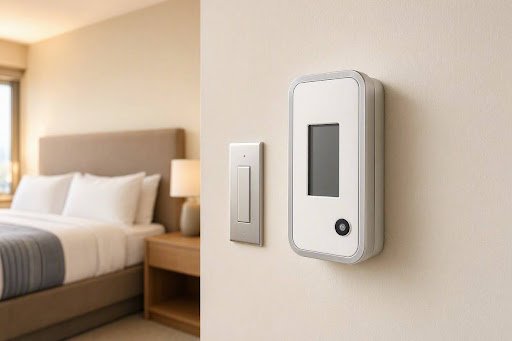
A guestroom that sits empty for hours does not need to be heated or cooled as if someone is standing right in front of the thermostat. Yet in many hotels, that is exactly what happens. Motion sensors built into modern thermostats solve this problem quietly, in the background, without guests ever needing to think about it. Understanding how these sensors actually work helps explain why they have become such a standard feature in hospitality HVAC.
This article looks at how motion sensing works in hotel thermostats and why it matters for both energy costs and guest comfort.
What Motion Sensing Actually Does
At its core, a motion sensor built into a thermostat detects whether a room is occupied. Most hospitality thermostats use passive infrared, or PIR, technology to do this. The sensor picks up changes in heat patterns caused by movement, such as a guest walking across the room or moving around while unpacking.
When no movement is detected for a set period, the thermostat can shift into a lower-energy setback mode. Once the sensor picks up movement again, whether from a returning guest or housekeeping staff, the system returns the room to its normal comfort setting.
Why This Matters More in Hotels Than Homes
Home thermostats with motion sensing are becoming common, but the stakes are different in a hotel setting. A single home has one household with fairly predictable patterns. A hotel has dozens or hundreds of rooms, each with a different guest, different schedule, and different amount of time spent physically in the room.
Guests are often out of their rooms for large parts of the day, whether sightseeing, attending meetings, or simply out at meals. Without motion sensing, a thermostat has no way to know this and continues conditioning the room as if someone were there the entire time. Multiply this across a full property, and the energy waste adds up quickly.
How Setback Timing Works
Setback timing refers to how long the thermostat waits after detecting no motion before adjusting the temperature. This setting matters more than it might seem.
- Too short a delay can cause the system to shift into setback mode while a guest is simply sitting still, reading, or sleeping, leading to discomfort.
- Too long a delay reduces the energy savings, since the room continues running at full comfort settings long after a guest has left.
Most hospitality-grade thermostats allow engineering staff to adjust this timing based on the specific needs of the property, striking a balance between guest comfort and energy performance.
Guest Comfort Is Still the Priority
A common concern with motion-sensing thermostats is that guests will notice the temperature shifting and find it unpleasant. Well-designed systems avoid this by keeping the setback range modest rather than extreme, and by responding quickly once motion is detected again.
The goal is not to make guests uncomfortable while they are away. It is to avoid wasting energy conditioning an empty room, then quickly return to a comfortable setting the moment someone is back. Done well, most guests never notice the system working at all.
Benefits Beyond Energy Savings
While energy savings tend to get the most attention, motion sensing offers a few other practical advantages for hotel operations.
- Reduced HVAC wear. Systems that run less often when rooms are unoccupied experience less overall strain, which can extend equipment lifespan.
- Data on room usage patterns. Some systems can provide insight into occupancy trends, which can help with staffing and maintenance planning.
- Consistency across the property. Motion-based setback applies the same logic to every room automatically, rather than relying on guests to remember to adjust settings themselves.
Choosing a Thermostat With Reliable Motion Sensing
Not every motion sensor performs the same way. When evaluating options for a property, it helps to look at sensor placement, detection range, and how the system distinguishes between genuine occupancy and brief movement like housekeeping passing through the hallway.
A thermostat such as the HotelTech smart hotel thermostats lineup, built specifically for standalone hotel rooms, combines motion detection with adjustable setback timing designed around real hospitality use, rather than settings borrowed from a residential product.
The Research Behind Occupancy-Based Controls
The energy case for occupancy sensing is well documented outside the hospitality industry as well. According to a guidance fact sheet from the U.S. Department of Energy’s Better Buildings Solution Center, pairing occupancy sensors with HVAC controls to adjust temperature setpoints and airflow can produce energy savings that are often greater than the savings achieved through occupancy-based lighting controls alone. You can review the full guidance in their wireless sensors fact sheet for more detail on how these systems are evaluated.
Motion sensors have quietly become one of the most useful features in modern hotel thermostats, cutting energy waste without asking anything of the guest. The technology works best when setback timing is tuned carefully, balancing real savings against guest comfort. For hotels looking to modernize their guestroom HVAC, motion sensing is one of the clearest places where a small feature can make a meaningful difference across an entire property.
