


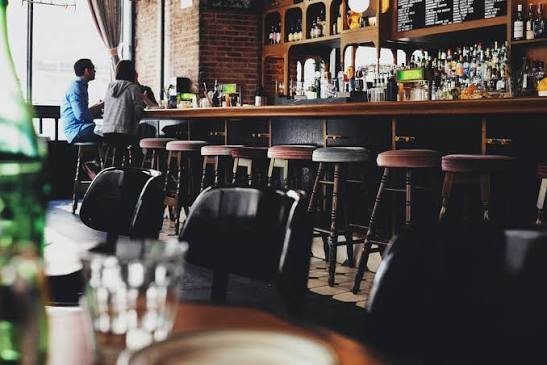
Most restaurant budgets file seating under furnishings, alongside artwork, planters and the thing above the entrance. That classification determines who signs the order, what questions get asked, and how the decision is justified, and in the case of one specific item it produces consistently poor outcomes.
Operators who have run bars for a while have moved bar stools into a different category entirely. They treat them the way they treat a coffee machine or a point-of-sale terminal. It is equipment with a throughput, a duty cycle and a measurable effect on revenue, evaluated on what it produces rather than on how it looks.
The Reclassification Changes the Questions
Start with what actually changes when the line item moves.
Furnishings get asked how they look, what they cost, and whether they match. Equipment gets asked what its capacity is, what its service life is, what the parts cost, and what happens to revenue when it stops working.
Applied to a stool, the second set of questions produces a completely different specification. Nobody buying a coffee machine accepts a description of it as sturdy. They ask for a throughput figure and a service schedule, and the same information exists for seating.
The Throughput Number Nobody Calculates
Equipment has a capacity, and a stool has one that can be worked out from data every bar already holds.
Take the seat count at the bar, multiply by turns per evening, multiply by average check at the bar. That is the annual revenue passing through a small number of physical objects, and in most bars the figure is larger than anybody expects.
Divide by seat count and you have revenue per stool per year.
Compared against the purchase price of a stool, the ratio is usually somewhere between twenty and a hundred to one. No operator would specify a coffee machine casually at that ratio.
A wobbling stool is not a hundred dollar problem. It is a seat nobody chooses, at a bar with eight of them, on every busy evening until somebody fixes it. That is lost covers rather than a maintenance item, and it does not appear in any ledger.
The same logic applies to a seat that becomes uncomfortable at the forty-minute mark. It does not break, and it quietly caps every guest at one drink instead of two. Equipment that runs at half capacity gets replaced. Furnishings that look fine do not.
What Comfort Buys, in Revenue Terms
There is a mechanism here worth stating precisely, because it is the whole commercial case.
Bar revenue is disproportionately second-round revenue. The first drink is ordered by somebody who came in intending to have one. The second is ordered by somebody who is comfortable enough not to have thought about leaving.
That decision happens somewhere between minute thirty and minute sixty, and it is governed by the footrest, the seat edge and whether there is any back support. The National Restaurant Association’s state of the industry work describes a business running on thin margins where repeat visits and full checks carry the operation. The second drink is where a bar’s margin actually lives.
Equipment Has a Maintenance Schedule
The third consequence of the reclassification is procedural and it is the cheapest change available.
Nobody services stools, because furnishings do not have service intervals. Equipment does. A bar that checks leveling adjusters, glide condition and joint tightness on a fixed schedule catches every one of the failures above before a guest experiences them.
That is a twenty-minute job monthly for a run of eight stools. The alternative is discovering each fault when somebody sits on it, which is the most expensive possible moment.
The Labor Line the Stool Sits In
There is a fourth argument that appeals to finance rather than to operations.
Stools get moved constantly: for cleaning, for deliveries, for events, for anything that requires access to the bar face. Weight and stackability decide how long that takes, every single day, forever.
The Bureau of Labor Statistics tracks a large and hard-to-staff food preparation and serving workforce, and in that market the minutes are not free. A stool specified as equipment gets weighed before purchase. One specified as a furnishing gets photographed.
Where the Compliance Requirement Fits
There is a requirement that also stops being optional once the bar is treated as a service counter.
Under the 2010 ADA Standards, bar counters are dining surfaces, and a proportion must be accessible with compliant knee and toe clearance, dispersed rather than clustered. A lowered section beside the service well satisfies the count and not the intent.
Equipment planning handles this naturally, because equipment gets specified for who uses it. Furnishing decisions handle it badly, because the accessible position is treated as a constraint on the design rather than as a seat somebody has to sit in.
What the Reclassification Looks Like in Practice
For an operator who wants to make this change on the next order:
- Calculate revenue per stool per year before looking at any product
- Specify footrest position, seat edge profile and back option as performance requirements
- Ask for a test report number rather than a durability adjective
- State a maximum weight, since these get moved daily
- Put stools on a monthly service check alongside the equipment schedule
- Design the accessible positions where a guest would choose to sit
The Line Item That Was Always in the Wrong Place
The interesting thing about this shift is that it costs nothing. The stools are not necessarily more expensive. What changes is who evaluates them and against what.
A furnishings decision is made for the photograph and the budget. An equipment decision is made for what passes through the object over a decade. In the case of a bar stool that is a number large enough to justify considerably more attention than it usually receives.
Bars that made the switch describe the same result. Not a better-looking bar, a busier one, for reasons nobody standing in it could name.
